Short answer: yes, sometimes
Custom tooling may qualify for SR&ED when standard solutions cannot achieve the required precision, repeatability, durability, or integration with production.
If your team had to design, test, and refine a new tooling approach because the outcome was not readily predictable, part of that work may be eligible.
What this usually looks like in practice
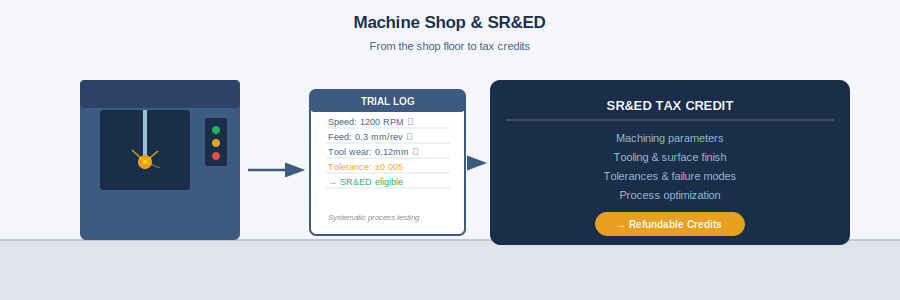
Machine Shops often face these issues when working with tight tolerances, difficult materials, automation requirements, or tooling that behaves unpredictably under real production conditions.
That can lead to structured experimentation with:
- tooling materials, surfaces, and wear behaviour
- fixture layouts, clamping methods, and pressure distribution
- cooling, vibration control, and thermal compensation
- alignment systems, sensors, and automation feedback
Examples of potentially eligible work
Examples can include efforts to:
- hold tighter tolerances in machining or assembly
- reduce vibration, deflection, or thermal distortion
- improve throughput or automation accuracy
- develop tooling for new materials or complex parts
Bottom line
Custom tooling can qualify for SR&ED when the work involves real technological uncertainty and a systematic effort to resolve it.
If the solution was not obvious and required iterative development, there may be a strong basis for a claim.
Get in Touch Today
Not sure if your tooling work may qualify? Contact us to discuss your project and whether there may be a supportable SR&ED claim.