Why Material Changes Can Become Technical
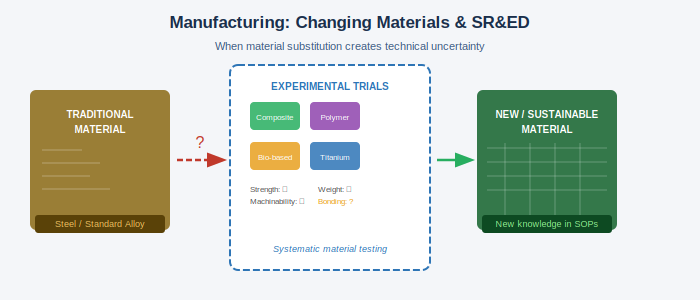
Changing materials is often routine, but when substitute materials behave unpredictably in production, the work may be worth reviewing for SR&ED.
Manufacturers change materials for many practical reasons. A supplier may discontinue a product, costs may rise, or a customer may require better durability, lower weight, greater flexibility, or improved resistance to heat, moisture, or impact.
At first, this may seem like a standard manufacturing decision. But a substitute material that looks acceptable on a data sheet can behave very differently in real production.
- Warp, crack, or fail to bond properly
- Cure differently or require unexpected machine adjustments
- Produce inconsistent finished parts or unexpected durability issues
When that happens, the company may need to test different approaches before it can achieve the required result. This is where SR&ED may apply
Material-related SR&ED can arise in plastics, metals, rubber, foams, resins, composites, molded parts, layered materials, and other manufacturing environments. The work may involve testing different material combinations, bonding methods, curing conditions, layering configurations, machine settings, cutting methods, or durability outcomes.
Routine Change or Technical Uncertainty?
The important question is whether a qualified person could reasonably predict the result using existing knowledge. If the answer is yes, the work is likely routine. If the answer is no, and the company had to investigate through testing, there may be a technical uncertainty worth reviewing.
A material that works on paper does not always work in production.
Practical Takeaway
If your company ran into material substitutions, bonding issues, composite challenges, or unexpected production failures, it may be helpful to review whether that work could support an SR&ED claim.
Get in touch today
Email us today to check your eligibility — info@carnegiecapitalgroup.com