Many manufacturers conduct legitimate SR&ED work without realizing it. In other cases, companies identify eligible projects but weaken their claims through avoidable documentation and reporting mistakes.
The reality is that many SR&ED claims fail not because the work was ineligible, but because businesses struggle to properly explain, document, and separate experimental work from routine operations.
Understanding the most common mistakes can significantly strengthen claims and improve recovery potential.
Mistake 1: Not Recognizing Eligible Work
One of the biggest issues in manufacturing is that companies often assume SR&ED only applies to formal laboratory research.
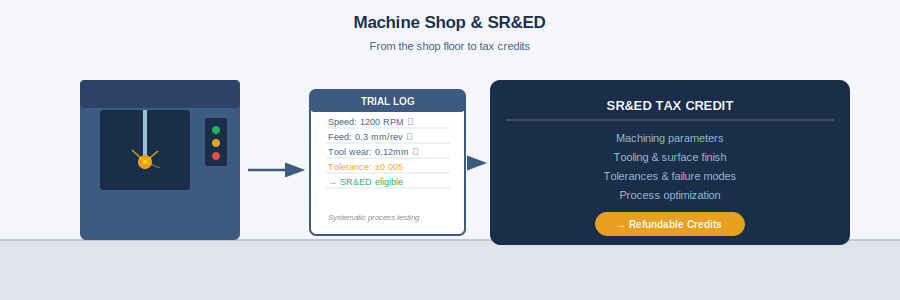
In reality, SR&ED frequently happens directly on the production floor, during pilot runs, while adapting equipment, improving yields, resolving defects, or developing new manufacturing processes.
Whenever a company faces technological uncertainty and must systematically experiment to solve a technical problem, the work may qualify.
A good habit is to regularly review technical projects and ask:
- Did we face uncertainty?
- Did standard methods fail?
- Did we experiment systematically?
- Did we learn something not previously known?
If the answer is yes, there may be SR&ED eligibility.
Mistake 2: Weak Technical Narratives
Another common problem is focusing too heavily on business outcomes instead of technical uncertainty.
For example, saying:
“We improved our manufacturing process to reduce costs and increase efficiency.”
does not explain why the work was technically challenging.
A much stronger narrative explains:
- the technical problem faced
- why standard solutions failed
- what experimentation occurred
- what was learned through testing
CRA wants to understand the investigative process — not just the commercial result.
The strongest claims clearly demonstrate how the company systematically tested variables, analyzed outcomes, and refined its approach through experimentation.
Mistake 3: Including Routine Production Activities
Many manufacturers unintentionally weaken claims by including routine production work that is not experimental.
Standard production runs, routine inspections, regular maintenance, calibration work, and following documented operating procedures generally do not qualify for SR&ED.
However, experimental production activities often do qualify when they are directly tied to resolving uncertainty.
Examples may include:
- pilot runs validating a new process
- trial batches testing formulations
- limited production runs evaluating modifications
- process validation experiments
The key is separating experimental activity from standard commercial production.
Only work directly related to technical investigation should be included in a claim.
Mistake 4: Missing Eligible Material Costs
Some manufacturers only claim labor expenses while overlooking valuable material costs consumed during experimentation.
In many cases, eligible SR&ED materials may include:
- trial materials
- prototype components
- scrap generated during failed experiments
- test specimens destroyed during analysis
- materials consumed during pilot runs
What generally does not qualify are materials incorporated into products sold commercially or materials used during routine production operations.
Properly separating experimental material usage from standard production materials is extremely important.
Mistake 5: No Evidence of Systematic Investigation
Some claims explain outcomes but fail to demonstrate the actual experimental process.
CRA wants to see evidence that the company:
- formed technical hypotheses
- tested variables methodically
- analyzed results
- adjusted approaches based on learnings
Ad hoc troubleshooting or random trial-and-error generally does not qualify. The strongest claims clearly show structured investigation and iterative development throughout the project.

Key Takeaways
Manufacturing SR&ED claims are strongest when businesses clearly identify technical uncertainty, separate experimental work from routine operations, and maintain strong contemporary documentation throughout the investigation process.
Clear technical narratives, accurate time tracking, material tracking, and evidence of systematic experimentation all play a major role in supporting successful claims.
Most importantly, failed experiments and unsuccessful testing attempts should not be ignored. In many cases, they provide some of the strongest evidence that genuine technological uncertainty existed.
The Bottom Line
Manufacturing SR&ED claims often fail not because the work was ineligible, but because companies do not properly recognize qualifying activities, document experimentation consistently, or separate technical investigation from routine production work.
Avoiding these common mistakes can significantly strengthen claims, reduce CRA challenges, and maximize SR&ED recovery opportunities.
Get in Touch Today
Carnegie Capital Group | SR&ED & Government Funding Specialists
Email us today at info@carnegiecapitalgroup.com to check your eligibility.