Life sciences and med tech companies often assume innovative work will qualify for SR&ED. In practice, the issue is not the product itself. It is whether your team faced a real scientific or technological uncertainty that could not be resolved using standard knowledge or routine methods.
Not Every Life Sciences Project Qualifies
That distinction matters because many projects involve product development, validation, testing, or regulatory work, but only some involve the kind of technical uncertainty CRA is looking for.
Where Uncertainty Usually Shows Up
In life sciences and med tech, uncertainty often appears when a product or process behaves unpredictably under real-world conditions. That may involve biocompatibility concerns, material interaction issues, formulation stability, sterilization affecting device performance, sensor drift, calibration limits, unexpected biological response, or repeatability problems during scale-up and manufacturing transfer. When these outcomes cannot be predicted in advance and the team must investigate through structured testing and analysis, the work may support an SR&ED claim.
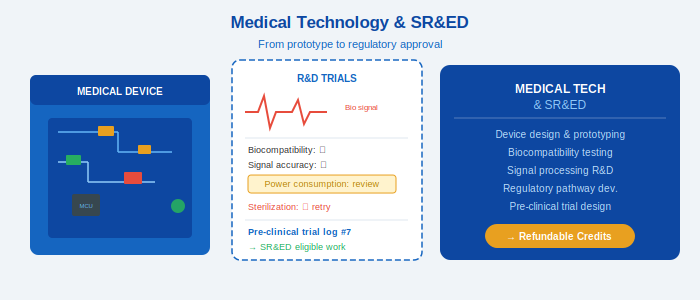
For example: a company developing a wearable medical sensor may find that the device performs reliably in bench testing, but loses accuracy after sterilization or during extended patient use. If the team must investigate whether the issue is caused by material interaction, signal interference, packaging constraints, or calibration drift, and the answer cannot be determined using standard methods alone, that technical investigation may form the basis of an SR&ED claim.
Strong claims are built on more than innovation alone. They need clear support showing what was uncertain, what work was done to resolve it, and what was learned. In practice, that often means capturing how teams tested material performance, assessed formulation behaviour over time, worked through integration challenges between hardware and software, or investigated why results changed between lab, pilot, and production settings.
A common mistake is assuming regulatory, validation, or routine development work automatically qualifies. It often does not. The strongest opportunities usually sit in the underlying technical investigation, such as resolving why a device loses accuracy after sterilization, why a formulation degrades before target shelf life, or why a process that worked in development does not remain stable or repeatable in production.
Get in Touch Today
Not sure whether your work may qualify? Carnegie Capital Group help life sciences and med tech companies identify where real SR&ED opportunities exist, separate eligible work from routine activity, and build claims that are grounded in technical evidence. A focused review can quickly show whether you may have a strong claim and where the best support is likely to come from.
Email us today at info@carnegiecapitalgroup.com