For years, one of the biggest limitations of the SR&ED program was straightforward: capital equipment generally did not qualify.
That has now changed. According to the CRA’s updated SR&ED capital expenditures policy, capital expenditures made after December 15, 2024, can qualify for SR&ED tax incentives, subject to the applicable rules and supporting facts.
For businesses that rely on pilot lines, test cells, lab setups, specialized instruments, or other equipment-driven development work, this may create a meaningful opportunity to improve the after-tax cost of innovation.
The real question is no longer simply whether an asset is capital in nature. The more important question is whether the equipment is used in a way that supports qualifying SR&ED work rather than routine commercial activity.
What’s Changing

If your company is building a pilot plant, running controlled trials on a dedicated line, using specialized testing equipment, or relying on production assets for experimental work, these changes may improve the economics of that work.
This may be especially relevant for manufacturers, clean technology companies, life sciences businesses, food producers, and other organizations whose development work depends on equipment-based testing.
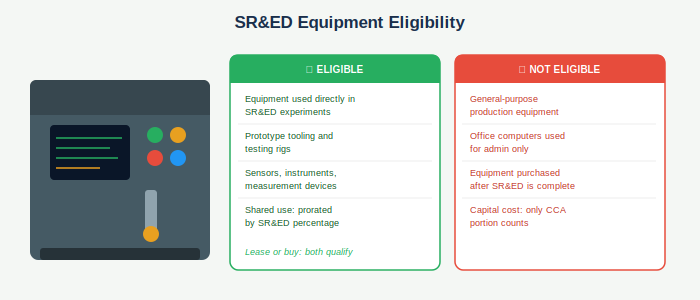
The distinction still matters. Equipment will not qualify simply because it is expensive, advanced, or newly purchased. The issue is whether it is being used to resolve technological uncertainty through qualifying SR&ED activities, rather than being used mainly for routine production or ordinary operations.
The CRA’s current policy reflects that capital expenditures made after December 15, 2024 may qualify, and it also outlines specific criteria, including use-based tests, additional restrictions, and documentation expectations.
For example, a manufacturer may use a pilot-scale line to test whether a new process can achieve stable output under variable conditions. A food company may rely on specialized lab equipment to determine whether a reformulated product can meet shelf-life or texture targets. A medtech or technology business may use dedicated instrumentation to measure performance during experimental trials where the outcome is not known in advance.
What to Track
- Review equipment purchases that are tied to experimental work, especially where acquisition timing and intended use may affect eligibility.
- Keep practical support such as usage logs, test records, project notes, and internal explanations showing how the equipment was used for SR&ED rather than routine commercial work.
For capital-intensive businesses, this is a significant development, but it should be approached as a planning opportunity rather than a blanket entitlement. Eligibility will still depend on how the facts are documented and how the equipment is used.
Need help assessing whether your equipment may qualify? We help Canadian businesses evaluate SR&ED eligibility, structure defensible claims, and identify the documentation needed to support capital-intensive development work. If you are investing in equipment tied to experimental development, contact us to discuss how these new rules may apply to your business.
Get in Touch Today
Email us today at info@carnegiecapitalgroup.com